Interview
Farah Abualjadayl
1 Congratulations on your achievements in the French Fashion Awards! Could you share a bit about your awarded design, yourself or your studio?
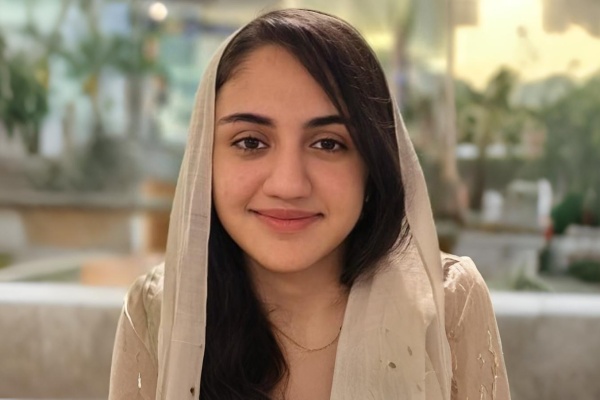
I’m Farah Abualjadayl, a 19-year-old Saudi student learning Fashion Design in between Medical lectures. What was merely a hobby now is a serious passion. To me, fashion can visually portray a message when words sometimes can’t. Although I’m just at the start of my journey, I hope to pursue Fashion Design and its sustainable applications.
2 What’s the one piece in your portfolio that you feel best represents your ideas, and why?
One of the first garments I’ve hand-sewn is a Victorian waistcoat. The sheer discipline, adherence to historically accurate sewing techniques, and fabric manipulation (like pad-stitching the lapels) really taught me much about proper tailoring. It truly resonated with me, as I like to revisit complex sewing methods where prior tailors would make the most out of their materials and find their modern implementations.
3 What inspired you to pursue a career in fashion design, and what motivates your creative journey?
It all started with me finding my Grandma’s sewing kit in high school. It started as a durable self-expression, since nothing in the shelves seemed to represent me or my personality, or last very long. But nowadays, I’m driven by the intersection of environmental science and art. Whether it’s in the goal or the design, environmental motifs have the most significant influence on my pieces.
4 What’s a day in your studio like—chaos, calm, or a bit of both?
I’d say it’s very serene and exact, but there’s a certain degree of inner-chaos. Because my projects are often meticulous, and commissions have time constraints, I’m always pushing my limits to ensure the highest quality products.
5 If you had to describe your design philosophy in three words, what would they be?
Whimsical, natural, and classical.
6 What was the “aha” moment when you knew you had to submit your winning designs to the award?
For the longest time, I thought my submission should only focus on showcasing maximum workmanship and skill to have a winning chance, until I realised that fashion can sometimes be about conveying a story. When I looked at the mermaid attire out of all of my other, more labour-intensive pieces, I realised that it told the most cohesive story of them all.
7 If fashion had no rules, what’s the boldest design idea you would bring to life?
If fashion wasn’t bound by the laws of physics, I’d really like to see abstract gravity-defying shapes in fashion. And if gravity was nonexistent, maybe we could even have fly-ways instead of runways.
8 What’s a trend you wish would make a comeback—or disappear forever?
I feel like hair accessories like Renaissance snoods should have their moment again. They add intrigue and can open up more possibilities for customisation.
9 How do you balance artistic freedom with the commercial demands of the fashion industry?
I believe that it’s important for all designers to split their time between their own passion projects and commissioned work to protect their creative liberty. Personal projects are an important outlet when you’re stuck making pieces that might not fully represent your vision.
10 If you could collaborate with any designer or artist, past or present, who would it be, and what would you create?
I’d pick Paul Poiret for his innovation and resourcefulness. Some of his pieces were even fashioned out of one piece of fabric alone, while still looking striking and elegant. I’d like to collaborate and make a similar fabric-conscious outfit, but inspired by my cultural heritage.
11 What does success in fashion mean to you—fame, impact, legacy, or something else entirely?
It means having a distinct style. Fame, impact, and legacy are controlled by external factors. But the quality of your work, the voice of your pieces, that’s true success and expertise.
12 How do you see fashion evolving over the next decade, and where do you see yourself in that position?
With the cycle of fast fashion coming to a halt, I believe we’ll start seeing a transition towards durability. It’ll be the age of not trend revivals, but rather technique throwbacks. This is already occurring in shoemaking spheres. I hope to provide long-lasting yet highly customizable outfits then.
13 What’s one piece of advice you’d give to your younger self as a designer, or those who are just starting out?
To focus on practising the methods of the era they’re inspired by, no matter how unconventional. All fashion borrows from the past and reimagines it into something new. So, being reverent to past silhouettes is exactly how you recreate them in modern reinventions.
14 If you could shape your life’s work into a single message to share with the world, what would it be?
It would be not conforming to other people’s perception, and wearing what you want, while also being conscious of your consumption.