Interview
Xinyi Chen
1 Congratulations on your achievements in the French Fashion Awards! Could you share a bit about your awarded design, yourself or your studio?
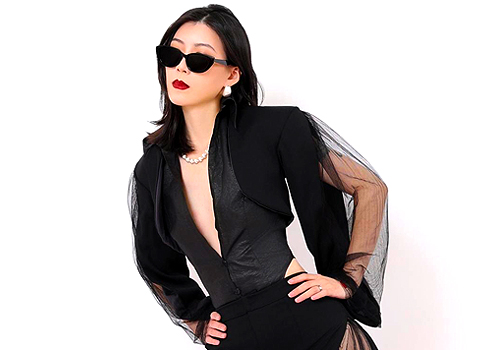
Thank you! I’m a fashion designer who transitioned into this field after earning an MBA, and I studied at FIDM in Los Angeles. The awarded piece, The Form of Power, is a conceptual look exploring the complexity of modern femininity. It blends contrasting materials—leather, suiting fabric, velvet, and mesh—to reflect strength, softness, confidence, and mystery. I created this piece to challenge narrow definitions of female identity and to reimagine sensuality as a form of control and empowerment.
2 What’s the one piece in your portfolio that you feel best represents your ideas, and why?
The Form of Power remains the most complete expression of my design values so far. It combines structured tailoring with fluid elements, and speaks to my core philosophy: that elegance must be grounded in function, and identity can be shaped through clothing. It’s not just a garment—it’s a conversation.
3 What inspired you to pursue a career in fashion design, and what motivates your creative journey?
Fashion gave me a language that business never could—it allowed me to speak about identity, gender, and emotion in a visceral way. What keeps me going is the belief that clothing can empower people, especially women. I’m drawn to design as a tool of narrative and change.
4 What’s a day in your studio like—chaos, calm, or a bit of both?
Definitely a bit of both. Some moments are very meditative—sketching, fabric draping, thinking in silence. Others are filled with fittings, unexpected issues, or impulsive ideas that take over. The creative process often lives between structure and improvisation, just like my designs.
5 If you had to describe your design philosophy in three words, what would they be?
Structure, intention and empowerment.
6 What was the “aha” moment when you knew you had to submit your winning designs to the award?
After completing The Form of Power, I saw how clearly it embodied not only my aesthetic values but also the social themes I care about. It felt personal, purposeful, and timely. That sense of alignment pushed me to take the step and share it with a broader audience.
7 If fashion had no rules, what’s the boldest design idea you would bring to life?
I would design garments that can shift in form, texture, or structure based on the wearer’s changing emotional or situational needs—almost like a visual mood ring, but functional. Imagine a single dress that transforms from professional to romantic to protective with a subtle gesture, or layers that reconfigure depending on how you want to be seen. It’s about reclaiming control, giving people the ability to redefine themselves moment by moment through what they wear.
8 What’s a trend you wish would make a comeback—or disappear forever?
I’d love to see the return of quiet tailoring—clothes that don’t scream for attention but carry weight in detail, structure, and message. As for a trend I’d gladly say goodbye to: overdone logo branding that replaces design with noise.
9 How do you balance artistic freedom with the commercial demands of the fashion industry?
It’s a constant negotiation. I believe the key is to stay clear on your values while being flexible with how they are expressed. For me, even when designing for commercial appeal, I try to embed subtle structure, thoughtful material choices, and a sense of intention. It’s possible to create with depth while still being wearable and relevant.
10 If you could collaborate with any designer or artist, past or present, who would it be, and what would you create?
I would choose Alexander McQueen. His fearless storytelling and structural genius have always inspired me. I imagine creating a collection with him centred on the idea of “unarmored strength”—garments that visually peel away layers of protection while revealing the complexity beneath. We would work with tension: sharp tailoring meets raw textures, delicate fabrics clash with sculptural silhouettes. It would be a celebration of vulnerability as a form of power.
11 What does success in fashion mean to you—fame, impact, legacy, or something else entirely?
For me, success means resonance. If a piece I design makes someone feel seen, powerful, or understood, that’s success. Recognition is meaningful, but impact—especially on how people relate to their bodies and feelings—is what I value more.
12 How do you see fashion evolving over the next decade, and where do you see yourself in that position?
I believe fashion in the next decade will shift from aesthetics-driven to values-driven. We’ll see a stronger focus on sustainability, emotional storytelling, and personalised expression, fueled by both material innovation and digital tools. Personally, I see myself creating work that merges tactile craftsmanship with intelligent design systems. I want to design not just garments, but experiences—where structure, technology, and identity all speak at once.
13 What’s the most surprising source of inspiration that has influenced your designs?
One of the most surprising sources was the feeling of being physically and emotionally constrained, like sitting too long in stiff formalwear during a long meeting. That small discomfort made me reflect on how clothing often mirrors societal expectations, especially for women. It inspired me to design garments that play with tension: restrictive structures paired with fluid layers, creating space where pressure once existed.
14 What’s one piece of advice you’d give to your younger self as a designer, or those who are just starting out?
Don’t wait to feel ready. You grow by doing, not by perfect planning. Your voice matters, even if it’s not yet polished. Start with what you have, and let the process shape you.
15 If you could shape your life’s work into a single message to share with the world, what would it be?
That clothing is not just what we wear—it’s how we define ourselves. Through structure, texture, and choice, we can reclaim authorship over our identity. Fashion can be a tool of self-determination, not just self-decoration.